Wealth of Misconceptions
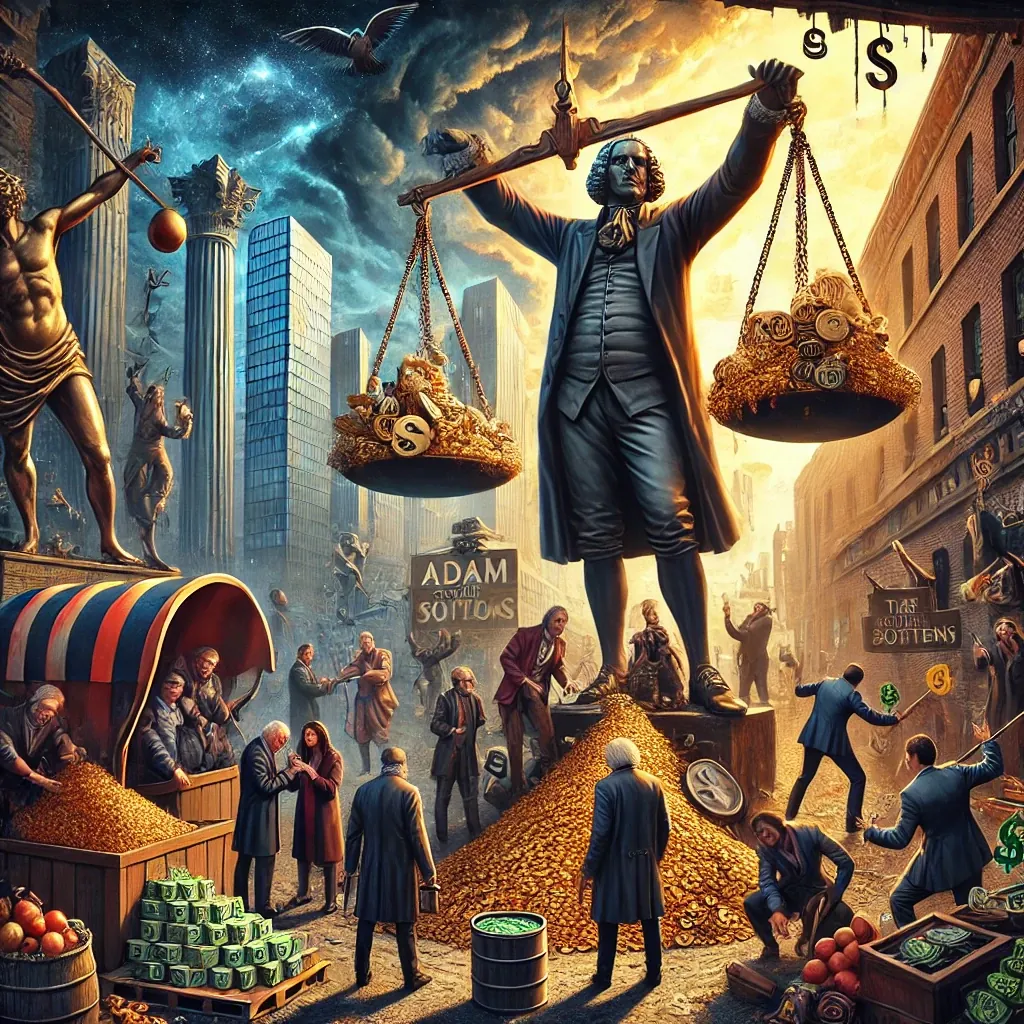
Adam Smith, often regarded as the “father of modern economics,” is a figure whose ideas have been widely cited, admired, and, unfortunately, frequently misrepresented. His foundational works—The Wealth of Nations (1776) and The Theory of Moral Sentiments (1759)—are complex texts that explore the interplay between economics, morality, and society. This article explores some of the most common misrepresentations of Smith’s ideas, particularly those surrounding the “invisible hand,” laissez-faire economics, self-interest, regulation, and the relationship between markets and morality. It also considers a contemporary example: the debate over Environmental, Social, and Governance (ESG) investing and the way Smith continues to function as a symbol of market capitalism. Elon Musk provides a useful illustration. Musk has repeatedly expressed admiration for Smith, writing in 2018, “Adam Smith FTW obv,” while praising competition and condemning monopolies, and later declaring, “Marx vs Adam Smith -> Adam Smith for the win. Not even close.” Musk’s subsequent attacks on ESG were not themselves quotations of Smith, but the combination illustrates how readily Smith’s name has become shorthand for a particular conception of markets—one that represents an important part of his thought, but far from the whole of it.
The “Invisible Hand” in Context
The “invisible hand” is arguably Adam Smith’s most famous metaphor, yet it is also one of the most misunderstood. Smith used the phrase exactly three times across all his works: once in The Theory of Moral Sentiments (1759), once in The Wealth of Nations (1776), and once in his “History of Astronomy” (published posthumously). In The Wealth of Nations, Smith describes how a merchant, by investing domestically rather than internationally, may unintentionally promote national economic well-being.
In The Theory of Moral Sentiments, the metaphor appears in a rather different setting. Smith describes a wealthy landowner who may possess vastly more than he can personally consume, yet must distribute much of the produce of his land among the people whose labor sustains his wealth and luxury. The result, Smith argues, is an unintended distribution of the “necessaries of life” among others. The point is not simply that wealthy people create employment, but that individual motives can produce social consequences that the individuals themselves neither intended nor necessarily cared about.
Seen in context, the “invisible hand” is better understood as an observation about unintended consequences than as a universal law declaring that selfish behavior always produces the best possible social outcome. Nothing in Smith’s three uses of the phrase establishes that private self-interest invariably serves the public good, or that government action necessarily makes matters worse. Turning the metaphor into a blanket justification for laissez-faire economics asks three scattered passages to carry considerably more theoretical weight than Smith himself ever placed upon them.
Smith Was Not a Pure Laissez-Faire Advocate
Another common misrepresentation is the portrayal of Smith as an advocate for an absolute or doctrinaire laissez-faire system. Smith strongly favored commercial freedom, competition, and limits on government interference, but he did not treat economic liberty as an inviolable principle. He recognized legitimate public functions and, in specific circumstances, explicitly supported restrictions on private economic activity.
- Education: Smith was deeply concerned that repetitive, highly specialized labor could leave workers intellectually diminished and poorly equipped to participate in civic life. He therefore saw a legitimate role for government in encouraging and helping to provide basic education, although his proposals should not be confused with the modern system of universal state-provided schooling.
- Infrastructure: Smith assigned government an important role in maintaining public works and institutions—such as roads, bridges, canals, and harbors—that facilitated commerce but could not always be profitably or effectively provided through ordinary private enterprise alone. Where practical, he also favored making users bear some of their costs.
- Banking Regulation: Smith explicitly accepted restrictions on banking practices when unrestricted economic liberty could threaten others or destabilize society. In one of his clearest statements on the limits of economic freedom, he compared banking regulation to requiring firewalls between buildings: both interfere with natural liberty, but both can be justified when the actions of a few create serious risks for everyone else.
- Taxation: Smith’s general principle was that citizens should contribute toward government expenses in proportion to the revenue they enjoyed under its protection. At the same time, he explicitly accepted circumstances in which the wealthy might contribute more than proportionally, observing that such inequality in taxation was not necessarily unreasonable. Describing Smith simply as either an advocate or opponent of modern progressive taxation therefore imposes a later political category on a more nuanced position.
Smith was also famously suspicious of monopolies, cartels, and collusion among merchants and manufacturers. His hostility toward monopoly is entirely consistent with his defense of markets: competition mattered precisely because commercial interests could not simply be assumed to coincide with the public interest. None of this turns Smith into a modern advocate of an expansive regulatory state. His presumption generally favored economic freedom. But it does demonstrate that his support for markets was neither unconditional nor based on the belief that every exercise of private economic liberty must be left untouched.
The Overlooked Importance of Smith’s Moral Philosophy
Smith’s economic ideas cannot be fully understood without considering his moral philosophy, as outlined in *The Theory of Moral Sentiments*. In this earlier work, Smith explored the role of empathy, social bonds, and morality in human behavior. Contrary to the caricature of Smith as a cold advocate for self-interest, he argued that humans are inherently social beings with a capacity for sympathy.
Smith saw self-interest as just one aspect of human nature, balanced by a desire for social approval and moral behavior. For example, he wrote:
> “How selfish soever man may be supposed, there are evidently some principles in his nature, which interest him in the fortune of others, and render their happiness necessary to him, though he derives nothing from it except the pleasure of seeing it.”
This perspective reveals that Smith’s economic theories were deeply embedded in a broader vision of human morality and social responsibility—a dimension often ignored by his modern interpreters.
Misrepresenting Self-Interest
One of Smith’s most quoted passages is his explanation of how self-interest drives economic exchange:
“It is not from the benevolence of the butcher, the brewer, or the baker that we expect our dinner, but from their regard to their own interest.”
This passage is frequently treated as shorthand for the proposition that selfishness itself is socially virtuous, but Smith’s point is considerably narrower. Economic exchange does not require the butcher, brewer, or baker to act from benevolence; people can cooperate by appealing to one another’s interests. That is an observation about how exchange works, not a moral declaration that greed is admirable. Smith’s broader work makes clear that self-interest is only one motive among many, operating within a society sustained by justice, sympathy, social norms, and institutions. Markets can channel self-interest toward mutually beneficial exchange, but Smith never suggested that self-interest automatically becomes benevolent merely because it occurs in a marketplace.
The ESG Debate: A Contemporary Case of Misrepresentation
The contemporary debate over Environmental, Social, and Governance investing offers an interesting test of what can—and cannot—reasonably be claimed in Adam Smith’s name. Elon Musk, one of ESG’s most prominent critics, has also repeatedly expressed admiration for Smith. In 2018 Musk wrote, “Adam Smith FTW obv,” while adding that monopolies were the “true enemy of people” and that “competing to serve is good.” In 2020 he reiterated the comparison: “Marx vs Adam Smith -> Adam Smith for the win. Not even close.” Two years later, after Tesla was removed from the S&P 500 ESG Index, Musk attacked ESG itself as a “scam.”
None of this means that Musk claimed Adam Smith had rendered a verdict on ESG, nor could Smith possibly have done so. ESG investing, modern corporations, climate accounting, stakeholder governance, and contemporary securities markets belong to a world Smith never knew. Claiming that Smith either supported or opposed ESG in its present form would therefore be anachronistic.
What Smith did address was the broader relationship between self-interest, justice, and moral conduct. The Theory of Moral Sentiments makes clear that merely refraining from violating the rights of others represents a moral minimum rather than the highest standard of human conduct. Smith wrote:
“The man who is barely innocent, who only observes the laws of justice with regard to others, and merely abstains from hurting his neighbours, can merit only that his neighbours in their turn should respect his innocence, and that the same laws should be religiously observed with regard to him.”
This is not a theory of corporate social responsibility, and it should not be presented as one. It does, however, make it difficult to reduce Smith’s moral philosophy to the proposition that anything lawful and profitable is therefore morally sufficient. Smith distinguished between justice—the minimum that others may legitimately require from us—and the broader virtues by which people earn moral approval.
His economic writings likewise show that he did not regard “natural liberty” as absolute. Discussing banking regulation in The Wealth of Nations, Smith wrote:
“Such regulations may, no doubt, be considered as in some respect a violation of natural liberty. But those exertions of the natural liberty of a few individuals, which might endanger the security of the whole society, are, and ought to be, restrained by the laws of all governments.”
Smith immediately compared such restrictions to laws requiring party walls between buildings to prevent fires from spreading. Private liberty was important, but the fact that a regulation interfered with private liberty was not, by itself, sufficient reason for Smith to reject it.
The most defensible conclusion, therefore, is not that Adam Smith would have endorsed ESG. We cannot know that. It is that invoking Smith as authority for a general principle of “profit first, social consequences irrelevant” is equally difficult to sustain. His work contains a vigorous defense of markets and competition alongside an equally real concern with justice, institutional safeguards, monopoly, moral character, and the social consequences of economic activity.
Modern Misrepresentations of Smith
The distortion of Smith usually occurs not through outright fabrication but through selective emphasis. Different readers can quote genuine Smith and nevertheless produce radically incomplete versions of him.
- Self-interest without moral philosophy: The butcher, brewer, and baker passage is treated as though it defines Smith’s conception of human motivation, while The Theory of Moral Sentiments and its extensive treatment of sympathy, justice, virtue, and social approval disappear from view.
- Economic liberty without its qualifications: Smith’s strong presumption in favor of commercial freedom is remembered, while passages in which he explicitly accepts regulation, public works, education, taxation, and restrictions imposed for public safety receive far less attention.
- Competition without suspicion of commercial power: Smith’s defense of markets is remembered while his repeated warnings about monopoly, collusion, rent-seeking, and the political influence of merchants and manufacturers are frequently overlooked.
The result is not an entirely fictitious Adam Smith, but something subtler: a real thinker reduced to a selection of his most politically convenient sentences. Smith was an unusually systematic thinker about economics precisely because economics was, for him, inseparable from institutions, law, psychology, morality, and the structure of society. Removing those elements leaves something recognizable as Smith, but considerably smaller than the original.
Conclusion
Adam Smith’s ideas have survived for nearly two and a half centuries partly because they resist the simple ideological categories later generations repeatedly try to impose upon them. He was an extraordinary defender of commercial society, competition, specialization, and individual economic liberty. He was also a moral philosopher who distrusted monopoly and collusion, recognized legitimate public functions, accepted restrictions on economic liberty under some circumstances, and never reduced human motivation to greed.
The “invisible hand” was not a magical guarantee that whatever markets produce must be socially desirable. The butcher, brewer, and baker were not an argument that selfishness is a virtue. Smith’s preference for economic liberty did not prevent him from recognizing circumstances in which liberty could legitimately be restrained. None of those observations makes Smith an opponent of capitalism; indeed, they help explain the kind of commercial society he believed could endure.
Modern political arguments inevitably borrow authority from influential thinkers, and Adam Smith will continue to be recruited into them. The useful question is not whether Smith can be made to sound conservative, progressive, libertarian, or anything else by contemporary standards. With enough selective quotation, he can. The more interesting question is whether the Smith being invoked resembles the man who actually wrote The Wealth of Nations and The Theory of Moral Sentiments. Frequently, he does not.
References
1. Smith, A. (1759). *The Theory of Moral Sentiments*.
2. Smith, A. (1776). *An Inquiry into the Nature and Causes of the Wealth of Nations*.
3. Smith, A. (1795). “History of Astronomy,” in *Essays on Philosophical Subjects*.
4. Hanley, R. P. (2009). *Adam Smith and the Character of Virtue*. Cambridge University Press.
5. Rothschild, E. (2001). *Economic Sentiments: Adam Smith, Condorcet, and the Enlightenment*. Harvard University Press.
6. Kennedy, G. (2016). *Adam Smith: A Moral Philosopher and His Political Economy*. Palgrave Macmillan.
7. Phillipson, N. (2010). *Adam Smith: An Enlightened Life*. Yale University Press.
8. Macfie, A.L. (1971). “The Invisible Hand of Jupiter,” *Journal of the History of Ideas*, 32(4), 595-599.